
TABLE OF CONTENTS
Overview
Vouchers, also known as Gift Cards, are an important Ecommerce feature that organizations can use to increase sales, attract new customers, retain existing customers, promote products, reward loyalty, and support targeted marketing campaigns.
A voucher can provide a percentage discount, fixed-amount discount, free shipping benefit, gift card value, or other promotional incentives based on predefined business rules.
Znode supports voucher management through the Admin Console, allowing Administrators to create, assign, import, manage, and track vouchers across B2C and B2B Storefronts.
This article describes common business use cases for vouchers and explains how Administrators can configure and manage vouchers in Znode.
Business Use Cases
1. Customer Acquisition and Retention
Business Objective
Attract new Customers, encourage repeat purchases, and re-engage inactive Customers.
Use Cases
Organizations can use vouchers throughout the customer lifecycle:
- Provide a welcome voucher to newly registered Customers.
- Reward Customers after completing a purchase.
- Send vouchers to Customers who have abandoned a cart.
- Reactivate Customers who have not purchased within a defined period.
Examples
| Scenario | Voucher | Offer |
|---|---|---|
| New Customer Acquisition | WELCOME15 | 15% off the first order |
| Repeat Purchase Incentive | NEXT20 | $20 off the next order over $100 |
| Abandoned Cart Recovery | COMEBACK10 | $10 off if checkout is completed within 48 hours |
| Inactive Customer Reactivation | COMEBACK20 | 20% off the next order |
Business Benefits
- Encourage first-time purchases.
- Increase customer retention.
- Re-engage inactive Customers.
- Improve registration-to-purchase conversion.
- Recover abandoned carts.
- Increase customer lifetime value.
2. Seasonal and Clearance Promotions
Business Objective
Increase promotional sales while reducing excess inventory through targeted, time-limited voucher campaigns.
Use Case
Vouchers are applied to seasonal promotions, clearance events, or overstocked products and categories to drive demand and improve inventory turnover.
Examples
- SUMMER20: 20% off selected products during a seasonal promotion.
- CLEARANCE25: 25% off products in the Clearance category.
Business Benefits
- Supports seasonal marketing and promotional initiatives.
- Creates urgency through limited-time offers.
- Increases sales during promotional periods.
- Reduces excess and slow-moving inventory.
- Improves inventory turnover.
- Promotes targeted products or categories without discounting the entire catalog.
3. B2B Customer-Specific Voucher with Minimum Order Value Incentive
Business Objective
Provide targeted incentives to specific Customers while encouraging larger order values.
Use Case
Organizations often provide vouchers to selected B2B Customers as part of customer-specific promotions, contract negotiations, account growth strategies, or relationship management programs. To maximize the effectiveness of these promotions, voucher redemption can be restricted to orders that meet a predefined minimum order value.
This approach allows organizations to offer targeted incentives without modifying standard pricing, customer-specific pricing, or contract pricing agreements.
Common scenarios include:
- Strategic account promotions
- Preferred Customer incentives
- Contract renewal programs
- Account growth initiatives
- Customer retention campaigns
- Negotiated sales opportunities
Example
A Customer receives a voucher worth $500 that can only be redeemed on orders exceeding $5,000.
- Voucher: ABC500
- Offer: $500 off orders above $5,000
In another scenario, a Customer receives a $50 voucher that is valid only when the order value reaches $500.
Business Benefits
- Supports customer-specific promotional programs.
- Provides incentives without changing standard or contract pricing.
- Encourages Customers to increase order values.
- Increases average order value (AOV).
- Creates additional upselling opportunities.
- Helps strengthen strategic Customer relationships.
- Enables targeted B2B promotions while maintaining margin control.
Configuration Considerations
- The voucher can be restricted to a specific Customer account.
- A minimum order value can be configured as a redemption condition.
- Voucher validity can be controlled using start and expiration dates.
- Usage limits can be applied based on business requirements.
- Eligible Customers can be assigned directly through voucher configuration.
Example Business Scenario
A manufacturer wants to encourage a preferred distributor to increase quarterly purchasing volume. Instead of changing negotiated pricing, the Administrator issues a customer-specific voucher that provides a $1,000 discount on orders greater than $10,000. The distributor receives additional savings while the business encourages larger order sizes and maintains existing pricing agreements.
This use case combines customer-specific targeting and minimum order value incentives, making it particularly effective for B2B Ecommerce environments where organizations want to reward specific Customers while driving higher revenue per order.
4. Customer Compensation
Business Objective
Maintain customer satisfaction after service issues.
Use Case
Customer service teams issue vouchers following shipping delays, product issues, or other service disruptions.
Example
- Voucher: SORRY50
- Offer: $50 off the next order.
Business Benefits
- Helps resolve customer concerns.
- Maintains goodwill.
- Encourages future purchases.
5. Free Shipping Voucher
Business Objective
Reduce purchase barriers caused by shipping costs.
Use Case
Customers receive free shipping when redeeming a voucher.
Example
- Voucher: FREESHIP
- Offer: Free standard shipping on orders above $100.
Business Benefits
- Reduces checkout friction.
- Encourages order completion.
- Increases conversion rates.
6. Gift Card Store Model Using Vouchers
Business Objective
Enable a prepaid purchasing model where Buyers transact using voucher balances instead of traditional payment methods.
Use Case
Some B2B organizations operate a Storefront in which Buyers are not provided with standard payment methods such as credit cards, purchase orders, bank transfers, or other payment options.
Administrators issue vouchers that function as gift cards. Buyers can purchase products only when a valid voucher with available balance is assigned to their account.
This model is commonly used for:
- Corporate purchasing programs
- Employee allowance programs
- Educational purchasing accounts
- Government-funded purchasing programs
- Dealer and distributor spending programs
- Controlled budget management environments
Example
An organization allocates a quarterly purchasing allowance of $1,000.
- Voucher: GIFT1000
- Voucher Amount: $1,000
The Buyer places orders against the available voucher balance until the balance is fully consumed.
Business Benefits
- Provides complete control over Buyer spending.
- Eliminates reliance on traditional payment methods.
- Supports prepaid purchasing programs.
- Simplifies budget allocation and tracking.
- Functions as a gift card or stored-value payment mechanism.
- Supports customer-specific spending programs.
Storefront Experience
- The Buyer signs in to the Storefront.
- Products are added to the shopping cart.
- The assigned voucher becomes available during checkout.
- The voucher value is applied to the order total.
- The order is completed using the available voucher balance.
- Any remaining balance can be used for future purchases until exhausted or expired.
Configuration Considerations
- Vouchers can be assigned to specific Customers.
- Voucher balances can be managed by Administrators.
- Activation and expiration dates can be defined.
- Voucher balances are reduced when redeemed.
- Traditional payment methods can be removed from the Buyer experience when operating a gift card-only Storefront.
Configuring Vouchers
Znode supports multiple methods for creating and assigning vouchers.
Method 1: Create a Voucher from OMS
Navigate To
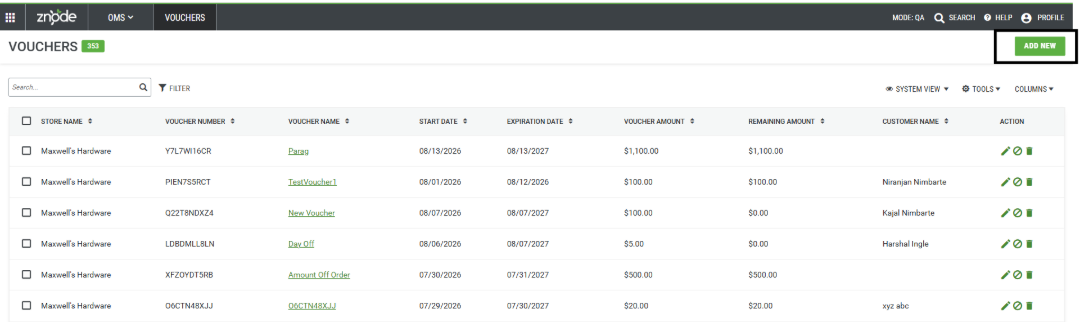
OMS > Vouchers
Create a Voucher
- Navigate to OMS > Vouchers.
- Select Add New.
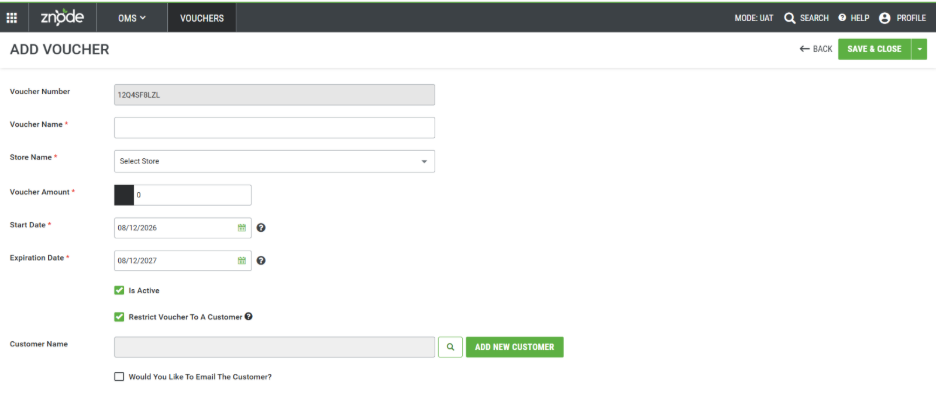
- Complete the voucher details.
- Select Save.
The voucher is created and becomes available based on the configured settings.
Voucher Fields
| Field | Description |
|---|---|
| Voucher Number | Auto-generated unique voucher identifier. |
| Voucher Name | Name assigned to the voucher. |
| Store Name | Store associated with the voucher. |
| Voucher Amount | Monetary value of the voucher. Cannot be set to 0. Validation: Voucher Amount must be between 0.01 and 999999. |
| Start Date | Date when the voucher becomes active. Validation: The Start Date cannot be earlier than the current date. |
| Expiration Date | Date when the voucher expires. |
| Is Active | Enables or disables voucher use. |
| Restrict Voucher To A Customer | Restricts voucher usage to a specific Customer. |
| Customer Name | Customer assigned to the voucher. |
| Would You Like To Email The Customer? | Sends voucher details to the assigned Customer using the New Voucher Issued For Customer email template. |
| Search | Search existing Buyers and Customers. |
| Add New Customer | Creates a new Customer and assigns the voucher. |
Voucher Behavior
- Voucher numbers are automatically generated.
- Assigned vouchers can be automatically applied during checkout.
- Buyers can remove vouchers during checkout if desired.
- Voucher details can be emailed to Customers.
Method 2: Create Vouchers Through Import
Navigate To
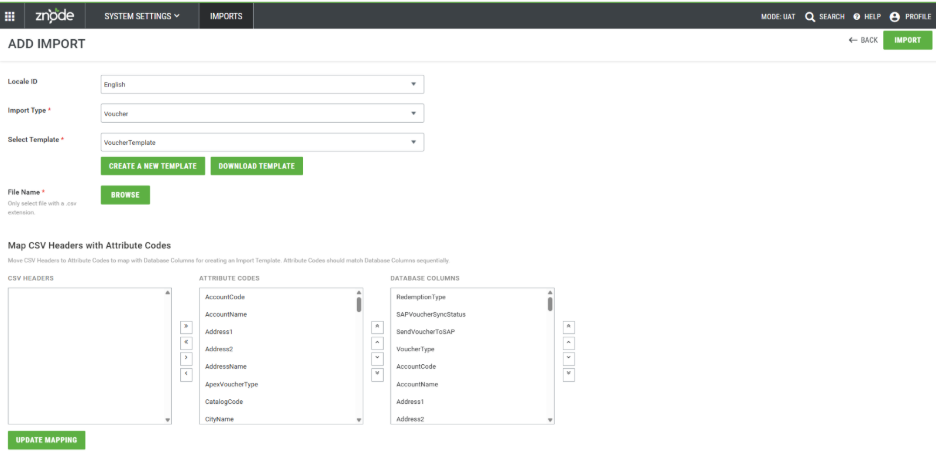
System Settings > Import > Voucher
Create Vouchers in Bulk
- Navigate to the voucher import area.
- Download the voucher import template.
- Populate the required voucher information.
- Upload the completed template.
- Complete the import process.
This method is recommended when creating multiple vouchers simultaneously.
Method 3: Create Vouchers from a User Record
Navigate To
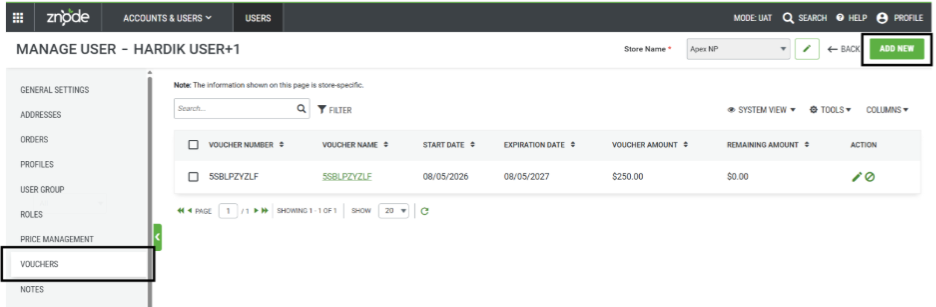
Accounts & Users > Users > Manage User > Voucher
Create and Assign a Voucher
- Open the required user record.
- Navigate to the Voucher tab.
- Select Add New.
- Complete the voucher details.
- Select Save.
The voucher is automatically associated with the selected user.
Voucher Visibility
Admin
Regardless of the method used to create, import, or assign a voucher, all vouchers are centrally managed and displayed in:
OMS > Vouchers
This includes vouchers created through:
- OMS > Vouchers > Add New
- System Settings > Import > Voucher
- Accounts & Users > Users > Manage User > Voucher > Add New
Administrators can use the OMS > Vouchers page to:
- View vouchers across the Store.
- Search and manage voucher activity and usage.
- Verify voucher details.
- Review assigned Buyers and Customers.
- Monitor activation and expiration dates.
- Track all vouchers regardless of how they were originally created.
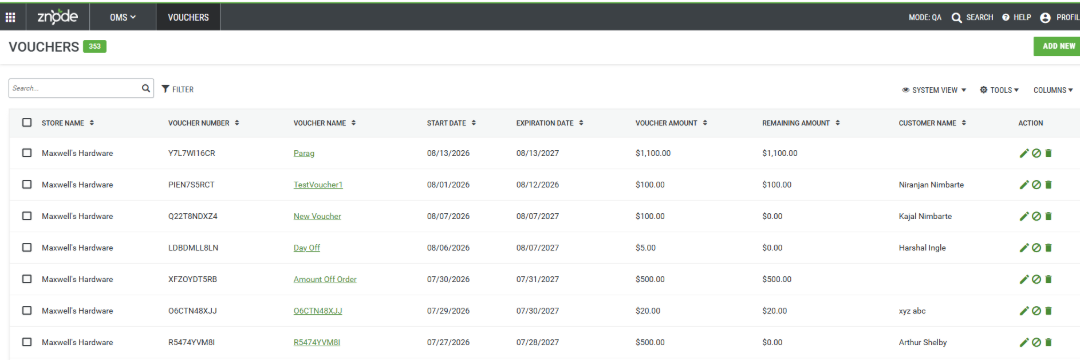
Voucher List Fields
| Field | Description |
|---|---|
| Store Name | Store associated with the voucher. |
| Voucher Number | Auto-generated unique voucher identifier. |
| Voucher Name | Name assigned to the voucher. |
| Start Date | Date when the voucher becomes active. |
| Expiration Date | Date when the voucher expires. |
| Voucher Amount | Monetary value of the voucher. |
| Remaining Amount | The remaining voucher balance available for use. |
| Customer Name | Customer assigned to the voucher. |
| Is Active | Indicates whether the voucher is enabled or disabled. |
Storefront
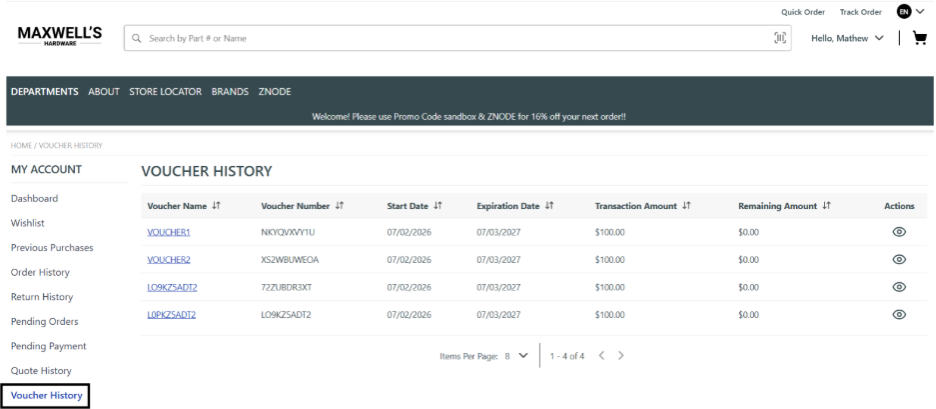
Assigned vouchers are displayed within the Customer account profile.
Navigate To
My Profile > Voucher History
The Voucher History page displays:
- Voucher Number
- Voucher Name
- Transaction Amount
- Remaining Amount
- Start Date
- Expiration Date
- Action
All vouchers associated with the Customer account are available for review in this section.
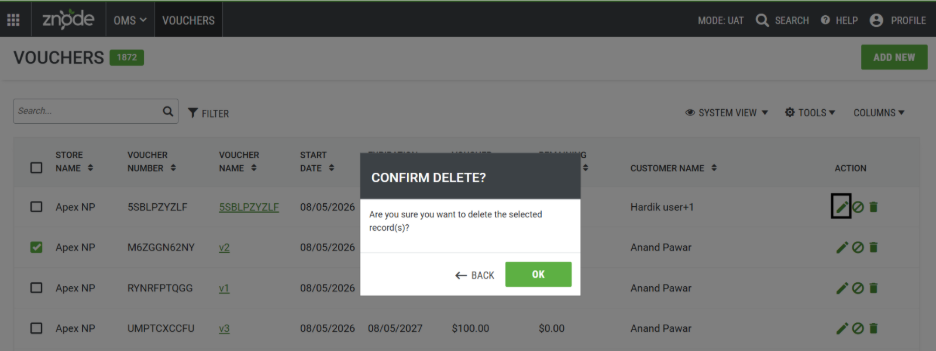
Deleting a Voucher
Navigate To
OMS > Vouchers
Delete a Voucher
- Locate the voucher.
- Select Delete.
- Confirm the deletion.
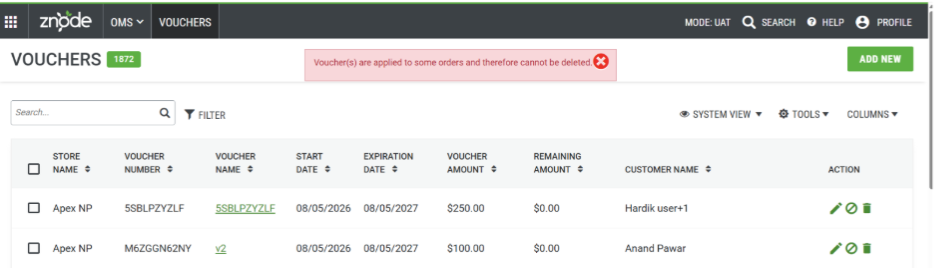
Important
A voucher that has been applied to one or more orders cannot be deleted.
The following message is displayed:
“Voucher(s) are applied to some orders and therefore cannot be deleted.”
Best Practices
- Define expiration dates to encourage timely voucher redemption and create a sense of urgency.
- Use customer-specific vouchers to support targeted marketing campaigns and personalized promotions.
- Create unique voucher codes to enable marketing attribution, campaign performance analysis, and ROI tracking.
- Restrict voucher usage when supporting employee, partner, dealer, distributor, or loyalty programs.
- Use voucher-based gift card models to support prepaid purchasing and controlled spending programs.
- Review voucher redemption activity regularly to measure promotion effectiveness and customer engagement.
- Periodically audit active vouchers to ensure alignment with current business objectives, promotional strategies, and organizational policies.